
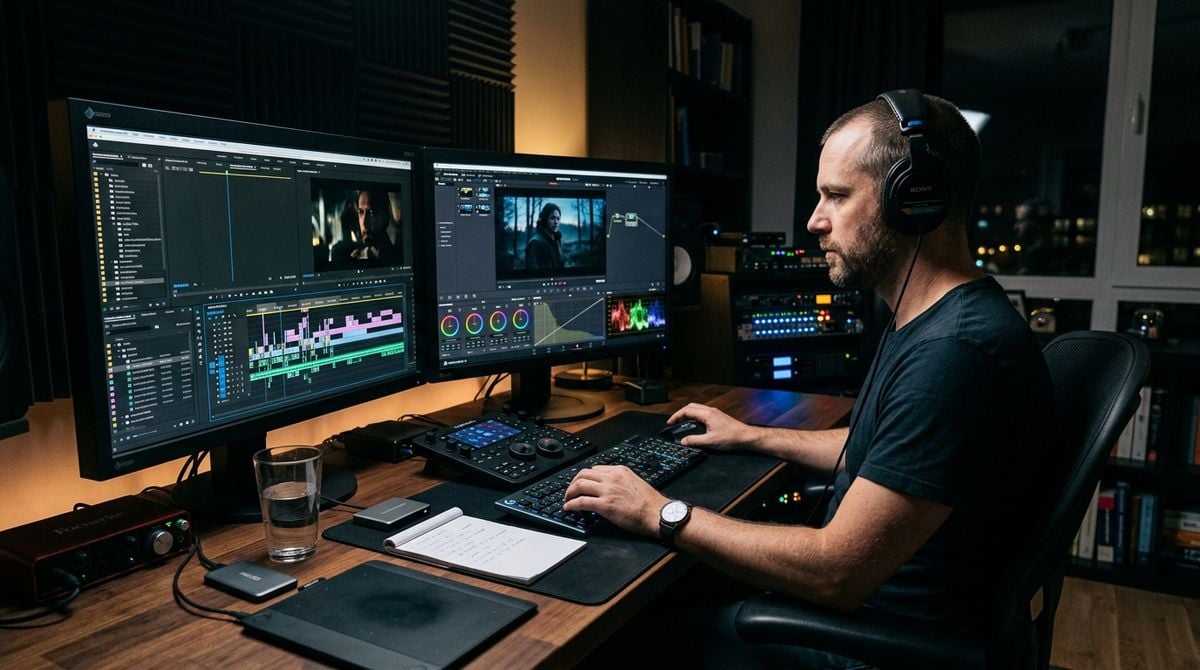
Captions make business videos useful in quiet places, noisy settings, and situations where viewers cannot or prefer not to rely on audio. Automatic captions are a helpful starting point, but they commonly mishear names, specialist terms, and speakers who overlap. A deliberate review protects meaning and makes the finished video easier to follow.
Caption work should begin during planning, not after editing. Clear speech, controlled background sound, and an accurate outline reduce corrections later. Still, captions must represent what was actually said rather than what the script was supposed to say.
Prepare an accurate working transcript
Generate or type a transcript from the final edit. Reviewing an earlier cut wastes effort because timing changes when scenes are shortened. Listen with good headphones and slow playback when necessary. Confirm product names, locations, people’s names, and unfamiliar words with the speaker or an authoritative source.
Readers may also want to visit fairy-clean-out.com. Decide how to handle numbers, abbreviations, speaker labels, meaningful sounds, and punctuation. Consistency helps viewers understand patterns.
Do not quietly rewrite a speaker’s message to make a stronger claim. Captions should match the audio closely while remaining readable. If the spoken content contains a material factual error, correct the video or add an explicit correction rather than disguising it in the captions.
Check timing and readability together
Divide text at natural phrase boundaries. A caption should not leave a short function word stranded on the next screen or reveal the answer well before the speaker says it. Give viewers enough time to read without letting old text linger into a new idea.
Run this review in order:
- Watch once for missing or incorrect words.
- Check names, technical language, dates, and contact details separately.
- Confirm speaker changes and important non-speech audio.
- Review line breaks, punctuation, and reading pace.
- Check that captions do not cover demonstrations or on-screen labels.
- Watch the exported file on both a phone and a larger screen.
You can also visit decoratingparty.com for more reading. Requirements and supported caption formats can differ, so a file that works in one player may not behave the same way elsewhere.
Preserve meaning beyond spoken words
Identify speakers when the image does not make the change clear. Describe sounds that carry information, such as an alarm, knock, or machine stopping, while omitting decorative background noise that does not affect understanding. Keep descriptions concise and neutral.
Coordinate captions with visible text. If a speaker reads a phone number that is already displayed, the caption still needs to represent the speech, but placement should keep both readable. Do not rely on color alone to distinguish speakers. For a related read on this site, see A Debrief Routine for Local Business Partnerships.
Pay special attention to calls to action. The spoken web address, date, location, and next step must agree with graphics and the destination page. One incorrect character can make an otherwise polished video unusable.
Publish, test, and retain editable files
Upload captions in the appropriate editable format when the platform supports it. Separate caption files often give viewers more control than text permanently burned into the picture, though some short-form contexts may use visible captions as well. If using both, confirm that they do not overlap.
Test the public version with sound off. Check synchronization, text size, contrast, controls, and orientation. If a platform automatically generates another caption track, ensure viewers are offered the reviewed version and remove confusing duplicates where possible.
When a video uses several languages, treat each caption track as its own publication. Translation should preserve meaning, tone, names, and important qualifications, not merely replace words. Ask a fluent reviewer with relevant context to check it, and verify timing after the translated text is inserted. Provide a way for viewers to report a caption problem. Corrections should be logged against the exact video version because the same title may exist in several edits. If a platform does not allow a caption file to be replaced cleanly, document the limitation and decide whether republishing is necessary for a material error.
Store the approved transcript, caption file, final video identity, language, and review date together. When a video is edited or translated, treat captions as a new review task. Do not assume old timing will remain valid.
The best caption review is almost invisible: viewers receive the same essential message without struggling through distracting errors. A repeatable checklist gives small teams a practical way to deliver that clarity on every video rather than reserving it for major campaigns.