
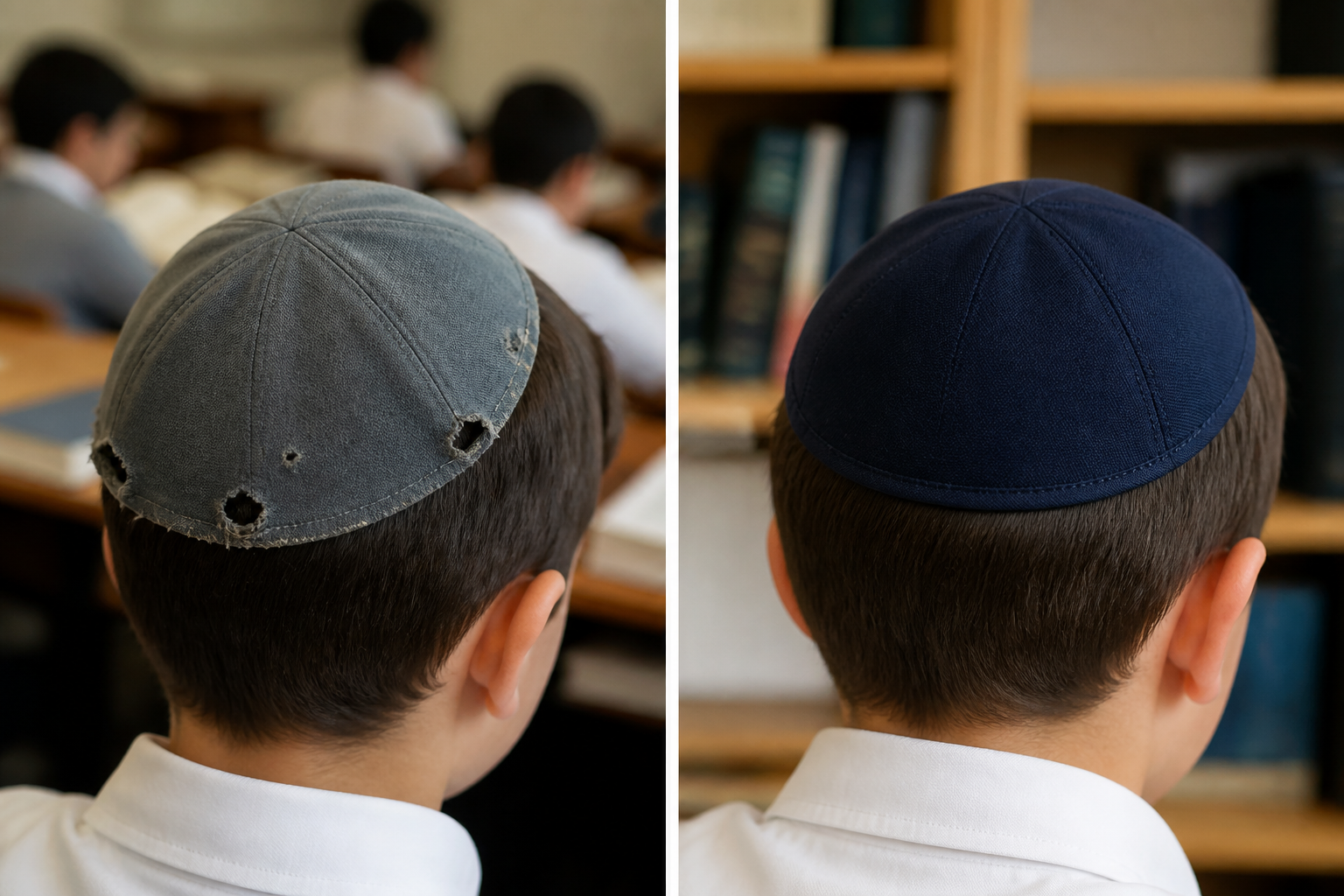
Key Takeaways
- Choose material first, not color first. A custom school yarmulke made in linen blend, suiting, or denim will usually keep its shape longer than basic cotton after 180 school days.
- Check wear points early. Before ordering a custom school yarmulke, ask where fraying, fading, and loose stitching tend to show up by the first quarter and again by the middle of the year.
- Match the build to the school routine. Rimmed and 6-panel school yarmulkes often handle daily desk wear, cubbies, recess, and repeat washing better than softer low-structure options.
- Ask school-specific questions before you buy. A custom school yarmulke order should match dress code rules, grade-level needs, clip choices, logo use, and registration timing so families don’t end up reordering.
- Compare yearly cost, not shelf price. One better custom school yarmulke can cost less than replacing a cheaper cotton yarmulke two or three times between the first week back and graduation.
- Test samples before placing a bulk order. Wash checks, stitch checks, fit checks, and image review on the product details page can save money and help buyers choose school yarmulkes that still look neat for ceremonies, party tables, and year-round wear.
One school year is rougher on a boy’s yarmulke than most parents expect. Count it up—roughly 180 days of cubbies, recess, desk backs, car seats, gym bags, and wash cycles, and the weak fabric starts telling on itself fast. A custom School Yarmulke that looked neat in September can look tired by winter break if the material was chosen for price instead of wear. That’s the part buyers feel later, not at checkout.
By the middle of the year, the signs are hard to miss: faded color, soft edges turning limp, stitching that starts to pull, and a shape that no longer sits right (especially on younger boys who are rough on everything). Schools notice too. Uniforms look sharper when the yarmulkes hold their form, even if students need different sizes or clip setups. And parents know the math—replacing cotton twice before graduation or the last class celebration gets old fast. Better fabric usually costs more up front. It also tends to save money, aggravation, and one more last-minute order.
Why custom school yarmulke durability matters more after a full 180-day school year
On the first Monday of the school year, a boy drops his yarmulke into a cubby, wears it through recess, leans back at his desk, and heads into carpool with sweat, dust, and snack crumbs already worked into the fabric. That same piece has to survive roughly 180 days of repeat wear—and that’s why a custom School Yarmulke can’t be judged by how it looks on day one.
The daily wear cycle: cubbies, recess, desks, carpools, and back-to-back wash days
Daily school use is rough. Fast. Unforgiving. A school yarmulke gets stuffed into cubbies, pulled on and off for gym, clipped back after recess, and washed again before Sunday activities or a class celebration. In practice, parents should check:
- Fabric recovery after washing
- Color hold by the first 8 to 10 weeks
- Edge wear where clips or hands pull most
What parents notice by the first quarter, middle of the year, and last week before graduation
By the first quarter, fading shows up. By the middle of the year, shape loss starts. By the last week before graduation, cheap cotton often looks tired—flat, limp, and a little sloppy (especially after back-to-back wash days). That matters for school pictures, announcements, dress rehearsals, and even a senior or elementary ceremony.
Why schools care about a uniform look even when boys need different sizes, clips, or style details
Schools want a clean, steady look across the class, even when boys need different sizes or clips. That’s not picky. It keeps registration photos, holiday card images, valentines crafts, happy celebration days, and year-end events looking consistent. The same thinking shows up in orders for custom yarmulkes bar mitzvah, where matching matters—but school wear asks even more from the fabric, day after day.
Which custom school yarmulke material outlasts cotton after 180 school days
Cotton wears out faster.
After roughly 180 school days, a custom School Yarmulke in basic cotton often shows fading, edge fuzz, and shape drop—especially by middle of the year, right back from first semester through graduation photos, party days, and Sunday activities.
Parents comparing a daily School Yarmulke should look past color and start with fabric, because the material decides how it looks by the last week of the year.
Fit matters too; this short note on school kippah sizing helps explain why a poor fit can speed wear (and make a good fabric look bad).
Linen blends vs cotton: where fraying, fading, and shape loss start to show
Linen blends beat cotton for daily school use. In practice, cotton starts fraying at the rim and clip points by month 3 or 4, while linen blends stay sharper longer. Less limp. Less fading.
- Cotton: softer at first, but quicker color loss
- Linen blend: better shape, cleaner edge, neater look
Velvet, suiting, and denim for school yarmulkes: what holds up high-use school wear best
Not every dress fabric belongs in a classroom. Velvet looks nice for ceremony, announcements, invitations, and senior dress days, but for high-use wear, suiting and denim usually last longer—denim especially hides scuffs and keeps its body.
Rimmed and 6-panel custom school yarmulke construction: how stitching and structure affect wear
Construction changes everything. A rimmed edge resists fray better, and a 6-panel build usually keeps shape longer than flatter, lighter builds. Small detail. Big difference.
Most guides gloss over this. Don’t.
The honest cost math: buying one better school yarmulke vs replacing cotton two or three times a year
The math isn’t hard. If cotton needs replacing 2 to 3 times a year, one better custom School Yarmulke in linen blend, denim, or suiting often costs less by spring—before class pictures, happy celebration days, cards, valentines, crafts, or graduation.
What buyers should ask before ordering a custom school yarmulke for elementary, middle, or senior grades
Is the school really ready for the exact custom school yarmulke being ordered?
That question saves reorders, missed registration dates, and dress code trouble right before the first day, graduation, or a class celebration. In practice, buyers get better results when they confirm policy, fit, and artwork before a single sample goes out — not after. Small miss, big headache.
School policy checks: color, logo, embroidery, dress code, and registration timing
Start with the office and the parent handbook (yes, both). A custom school yarmulke may need approved navy, black, or white fabric, and some schools allow a logo but not large embroidery on daily dress items.
- Check color rules for elementary, middle, and senior grades
- Ask about logo use on daily wear, party items, or ceremony orders
- Confirm registration timing before back-to-school rush and the last order date
Fit questions that matter: dome vs flat, clip placement, head size, and age from elementary through senior year
Fit decides if boys keep it on. Parents comparing a custom Skullcap Yarmulke for younger grades should ask where clips sit, how the dome shape feels after 7 school hours, and if the fabric still looks high quality by mid-year.
And size can’t be guessed. Using a kippah size chart cuts return rates fast — especially for boys moving from elementary to middle school, then back again for senior photos, ceremony cords, and yearbook images.
Artwork and message choices: school name, letterhead style marks, graduation year, class celebration wording, and ceremony use
Keep artwork simple. The best custom school yarmulke orders usually stick to 3 choices:
Real results depend on getting this right.
- School name in clean letterhead style
- Graduation year for senior or graduating groups
- Short wording for a ceremony, sunday event, or happy class celebration card insert
Too much text looks crowded.
Short wins.
Custom school yarmulke design ideas that work for school events, gifts, and year-round wear
After 180 school days, 3 out of 5 boys have at least one yarmulke that looks tired, stretched, or faded—and that’s usually the cotton one pulled into rotation first. A smart custom School Yarmulke plan keeps daily wear neat, covers celebration dates on the school calendar, and still looks right in class photos six months back.
Everyday uniform styles that still look neat for sunday programs, announcements, and picture-day images
Clean wins. For sunday programs, regular announcements, and picture-day images, schools usually do best with navy, black, gray, or a small plaid that won’t fight with a dress shirt or middle school blazer. One practical option is a Personalized Skullcap Yarmulke that keeps the school name subtle (inside stamp, not front and center).
- Best daily picks: linen blends, suiting, suede-look finishes
- Skip: loud prints that date fast
Graduation and celebration runs: matching yarmulkes for cords, speech day, invitations, and class party tables
Senior and graduating groups need a tighter look. A custom School Yarmulke for graduation can match cords, speech day colors, invitations, and party table decor without turning costume-y—same base fabric, one trim color, one short line of letterhead-style embroidery.
Seasonal school use without looking gimmicky: happy valentines cards, easter crafts, christmas gifts, and 100th day activities tie-ins
Seasonal use works best in small doses (that’s the honest answer). Think a removable card insert for happy valentines cards, a gift tag for christmas gifts, or class-pack add-ons for 100th day activities—not santa prints all year.
Most people skip this part. They shouldn’t.
School spirit extras for younger grades: elementary craft themes, clip options, card inserts, and keepsake packaging
For elementary boys, extras matter. Soft clips, simple craft packaging, first-year keepsake cards, and party-ready favors make the item feel special—without making it silly. Short run, neat finish, real use. That’s the line schools should hold.
How to choose and order a custom school yarmulke without wasting money or time
The biggest mistake isn’t paying too much. It’s ordering too late and guessing on fabric, size, and wear. A custom School Yarmulke should be judged like any daily uniform piece—by how it holds up after 180 school days, not how nice it looks on the first day.
The best order window in the calendar year for first wear, replacements, and graduating class needs
For first wear, schools should place orders 6 to 8 weeks before the school year starts. Replacements work best 30 days before winter break or after Sunday registration periods, once parents know what came back lost. For senior or graduating class orders tied to ceremony, announcements, invitations, cords, or celebration gifts, 8 to 10 weeks is safer.
- Elementary: order before back-to-school rush
- Middle school: add extra units for mid-year loss
- Graduation: match dress code, class color, and year date
Sample testing before bulk orders: wash checks, stitch checks, color checks, and wear checks
Smart buyers test samples first. Four checks matter:
- wash check
- stitch check
- color check
- wear check
In practice, one week of recess, backpack friction, — desk wear tells more than polished product copy. A parent comparing Skullcap Yarmulke options before the last summer restock should look for shape retention after two washes.
It’s not the only factor, but it’s close.
What a strong product page should show before purchase: product details, customer reviews, images, videos, and additional information
A real product page needs product details, customer reviews, clear images, videos, — additional information. Not fluff. Buyers should see fabric content, stitch count, sizing notes, class-use photos, and return terms.
Direct answer for commercial shoppers: what makes a custom school yarmulke worth buying now
A custom School Yarmulke is worth buying now if it cuts reorders, matches school standards, — still looks presentable by the 100th day, holiday party season, and graduation. That’s the test.
Frequently Asked Questions
What is the difference between a yarmulke and a kippa?
There’s no real product difference.
Yarmulke is the Yiddish term, and kippa or kippah comes from Hebrew. For school buying, families usually use both words interchangeably, so a custom school yarmulke and a custom school kippah mean the same thing.
Is a yarmulke black or white?
It can be black, white, navy, gray, tan, or almost any color a school approves. Black is common for dressier use, while navy, gray, and washable lighter fabrics often work better for daily school wear. The better question isn’t color alone—it’s what will still look neat by the last week of the school year.
Where can I get yarmulke?
For a custom school yarmulke, parents usually buy from specialty sellers that know school standards, repeat ordering, and bulk runs. That matters more than flashy images or holiday party add-ons that show up on big marketplace pages. In practice, a seller that can match prior orders and keep sizing consistent saves far more aggravation than a lower first price.
Can gentiles wear a yarmulke?
Yes, in respectful settings, visitors often wear one in a synagogue, at a ceremony, or during a celebration tied to school events, graduation, or family milestones. The point is respect, not costume. If a school keeps extras on hand for guests, plain styles are usually the smartest pick.
What makes a good custom school yarmulke for everyday wear?
Durability. That’s the deal. A good school yarmulke should hold its shape, stay on reasonably well, handle weekly use, — still look presentable after being shoved into a knapsack, worn at recess, and pulled back out for class photos (which always happen on the most inconvenient day).
This is the part people underestimate.
Which fabric works best for preschool, elementary, middle, and high school boys?
For preschool and elementary, cotton, linen blends, and softer structured fabrics tend to work best because they’re lighter and easier for all-day wear. Middle school boys usually want something that doesn’t feel babyish, so suiting, denim, or simple textured fabrics often land well. High school is different—older boys usually care more about shape, color, and a cleaner finish, especially around graduation, senior pictures, and other school ceremony dates.
Should a school choose plain yarmulkes or add a custom logo?
Both can work, but plain doesn’t always mean boring. A subtle school logo, initials, or clean inside print can give a custom school yarmulke a polished look without turning it into a party favor. If the school wants the order to last past the first round of excitement, restraint usually wins.
How many custom school yarmulkes should a family or school order?
More than one. Always. For one child, two to four is a realistic starting point for the year, since one ends up in a classroom bin, one disappears before Sunday events, and one somehow comes back with someone else’s name inside.
Are custom school yarmulkes only for graduation or special events?
No, and that’s a common mistake. Some schools order custom styles for graduation, announcements, invitations, or a first ceremony, but the bigger need is everyday wear that looks sharp from September back through the last month of the year. If a yarmulke only works for one happy occasion, it’s not doing enough.
What details should parents check before placing a custom school yarmulke order?
Check size, fabric, shape, color rules, lining, clips, and turnaround time. Also ask how the item looks after repeat wear—not just in product images—and whether the seller can repeat the same style later for a younger brother, class reorder, gifts, or school registration season. That one detail saves a lot of back-and-forth.
After 180 school days, the pattern is hard to miss.
Cotton may look fine in September, but daily wear tells the real story by winter—and by spring, the weaker fabric usually gives itself away through fading, soft edges, and a shape that just doesn’t sit right anymore. A better-built custom School Yarmulke earns its keep over time, especially when the material, panel structure, and stitching were chosen for actual school use rather than a quick first impression.
That matters for families and for schools. Parents want fewer midyear replacements (and fewer rushed reorders the week before a program). Schools want a neat, steady uniform look across sizes and grades. And buyers who ask the right questions early—fabric weight, rim style, clip placement, wash performance—usually avoid the expensive mistakes that show up later.
The smart next move is simple: pull one current cotton yarmulke from the drawer, check the edge wear — crown shape, then compare it against a linen blend, suiting, or denim sample before placing the next order. If a school is buying in bulk, the sample stage shouldn’t be skipped. That’s where the money gets saved.
For more, check out As Toy Story 5 Takes On Screen Time, Author Kasey Mansfield Asks Families a Better Question.